 Learning center
The Weekly Demo Sales Insights and Summary agent template is a Ragic AI Agent that, every Monday, turns last week's demo meeting minutes into a structured weekly sales report: key insights, top priority clients, deal-stage grouping, and a follow-up schedule.
Who is this for? Sales managers who need a clear view of the pipeline each week, and sales reps, account executives, and SDR teams who run product demos and need to know which follow-ups to prioritize.
Please register for a Ragic account first if you haven't already. After registering, you can start with the Free Plan. To explore more features, you can also apply for a 30-day free Professional Plan trial with no credit card required. No charges will be made without your consent. For more information, please refer to the Pricing Page.
After logging in, click the  icon in the top right corner to open the AI panel, then click AI Agent.
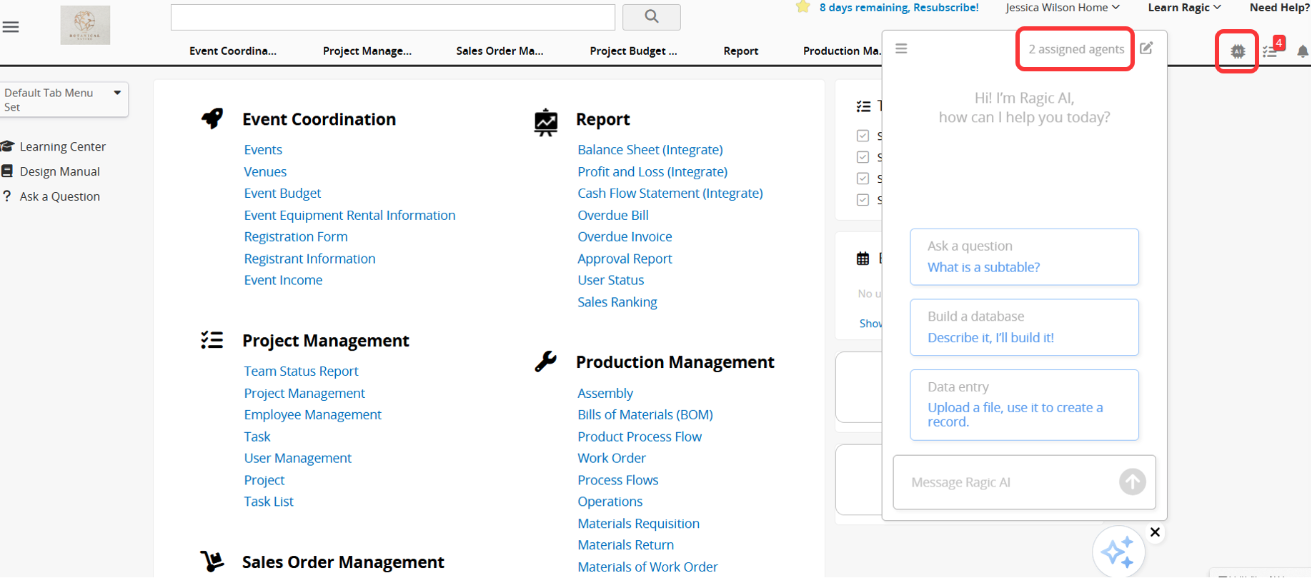
Before getting started with AI Agent, please note the following:
1. Running an AI Agent consumes AI Usage. The amount used varies depending on the complexity of the task and the selected Model.
2. Each database includes free monthly AI Usage for testing, and the amount varies by plan. Paid Plans include free usage based on the plan and the number of users. A Trial account receives a fixed amount of AI Usage for evaluation, regardless of plan or user count. The Free Plan also includes basic usage for testing. You can use the free AI Usage to explore and test the feature before deciding whether to upgrade your plan or purchase additional AI Usage.
3. When the free AI Usage is used up, the system will not charge you automatically. Instead, AI features will be paused. To continue using AI features, Paid Plans can purchase extra usage as needed. AI Usage is calculated in USD. Trial account cannot purchase additional AI Usage, and users on the Free Plan can continue using AI after monthly usage is refreshed. Charges are incurred only when you actively upgrade your plan or purchase additional AI Usage.
4. You can view the Usage Report for each Agent over the past 30 days, including call counts and usage costs. This helps you understand how AI Usage is being used and adjust Agent settings as needed.
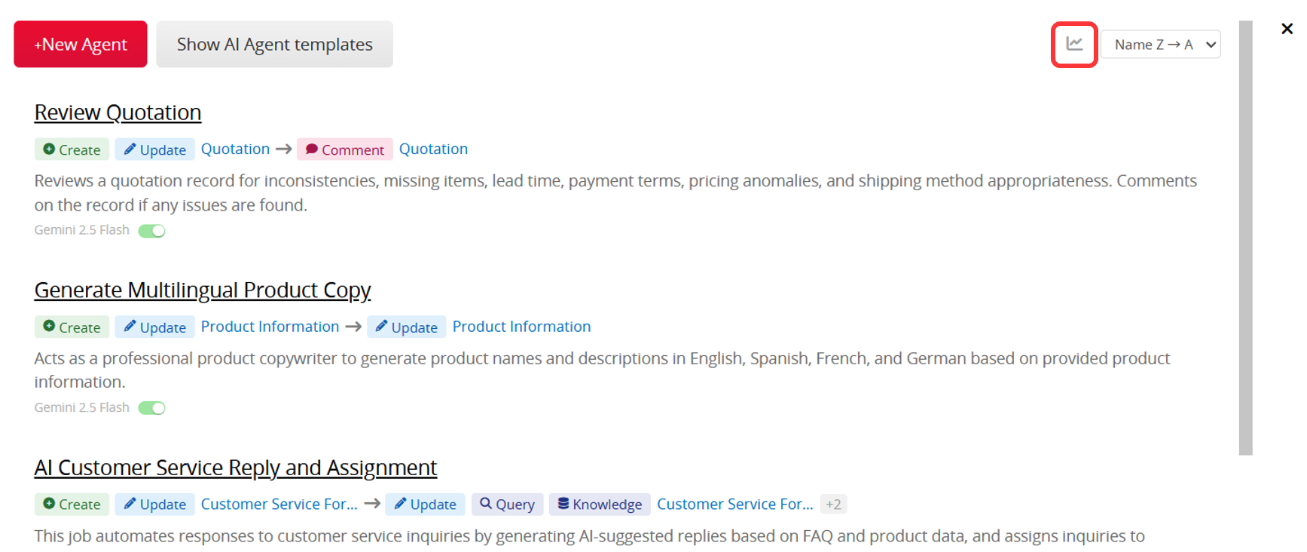
For more information, please refer to this article.
Find and apply the Weekly Demo Sales Insights and Summary template.
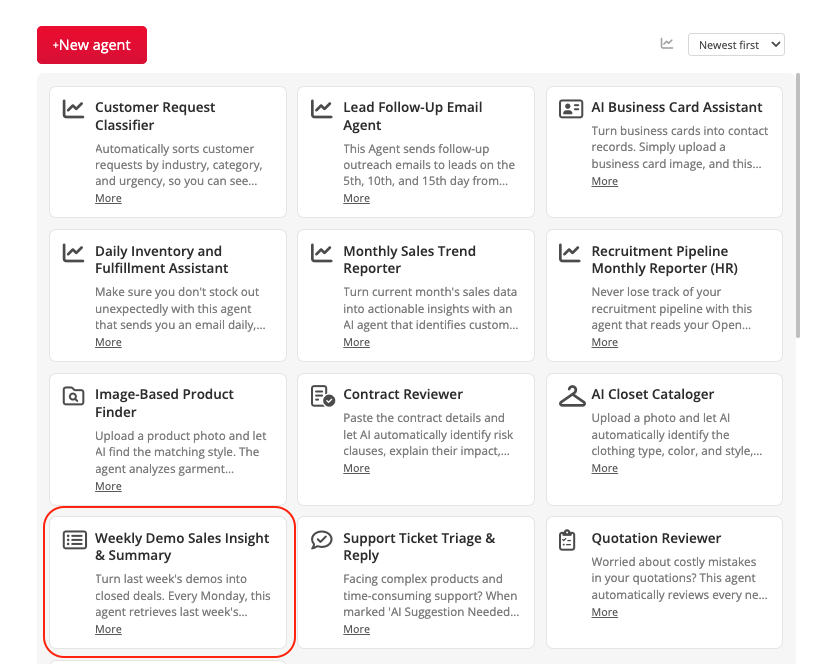
Depending on your current database needs, you can choose one of the following methods:
Method 1: Use the Template Sheets Directly
If your database is new or you have not yet created demo-related sheets, it is recommended to start with the template sheets. Once the template is saved, the system will automatically install two sheets and their settings: Demo Meeting Minutes and Weekly Sales Summary. You can begin testing immediately using the built-in fields and workflow without designing everything from scratch. This is also a quick way to understand how the AI Agent works.
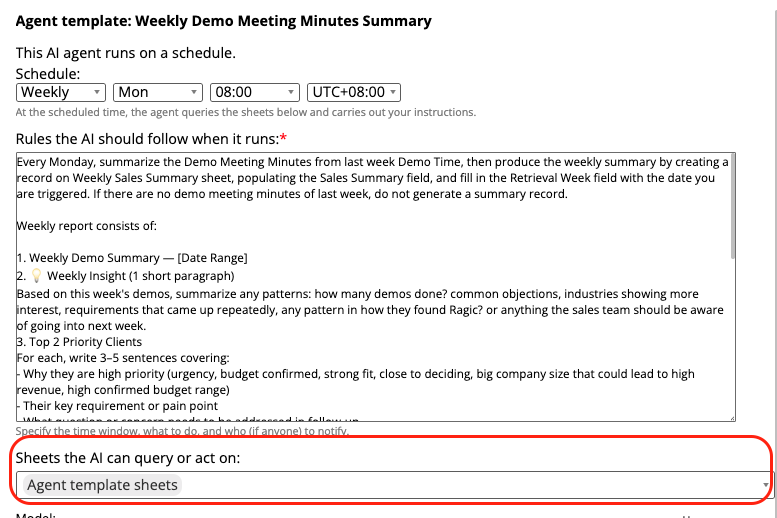
Method 2: Apply the Template to Your Existing Sheets
If your sales team already records demos in your own sheet, you can apply the AI Agent to your own sheets instead. Choose the sheets you'd like the agent to act on from your sheet list.
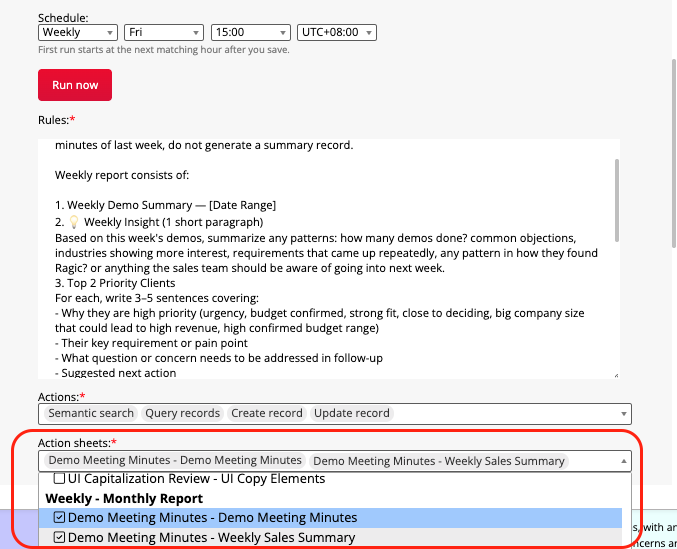
This option is ideal for teams with an established sales process, as it allows direct integration into current systems without rebuilding databases. However, after applying the template to your own sheets, you may need to adjust the Agent rules and settings, such as the field names the AI reads and the sheet it writes the summary to, to better fit your workflow. For more details, please refer to this section.
The template works with two sheets: one where your sales team records each demo, and one where the AI Agent saves the weekly summary.
After each demo, the sales rep fills in the meeting minutes. The sheet is organized into the following sections:
| Section | What to record |
|---|---|
| Meeting info | Demo ID, sales rep, demo time, follow-up date |
| Company info | Company name, contact person and email, industry, company size, notes about the company |
| Discovery | How they found your company, current tools, key requirements |
| Demo session | Questions the client asked and the answers given |
| Demo summary | Deal stage, expected decision timeline, likelihood of closing, estimated budget range, budget confirmed, decision maker present, client reaction, main concern or objection |
The more complete these records are, the more accurate the summary will be. The AI Agent bases its analysis strictly on what was recorded, so the "Demo time" and "Follow-up date" fields are especially important: the first decides which demos are included in the report, and the second decides which clients appear in the follow-up schedule.
Every Monday, the AI Agent looks at the demos whose Demo time falls in the previous week and creates a new record in the Weekly Sales Summary sheet. It fills in two fields:
If there are no demo meeting minutes from the previous week, the Agent does not create a summary record, so you will not see empty reports.
The Sales Summary field contains a structured report with five parts:
The report is written in Markdown so it is easy to scan, and any field left blank in the demo record is shown as "not recorded" instead of being guessed.
The template is only a starting point. You can adjust both the sheets and the AI prompt to match your sales process. Keep the two in sync: if you change a field in a sheet, update the prompt to match.
You can apply this agent to your own sheets, or edit the template sheets by adding or removing fields to fit how your team runs demos. For the basics, see how to create a Ragic sheet.
If you use your own sheets, or you have changed the template sheets, review the prompt and confirm the field names still match. For example, check that the fields the AI reads (such as deal stage, budget, and follow-up date) exist in your demo sheet, and that the field it writes the summary to exists in your summary sheet.
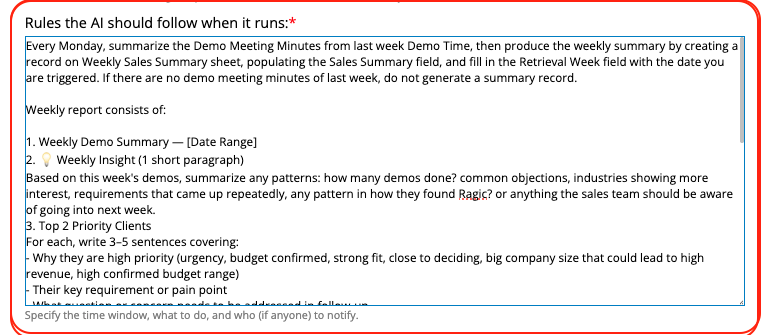
You can then tailor the report to your team:
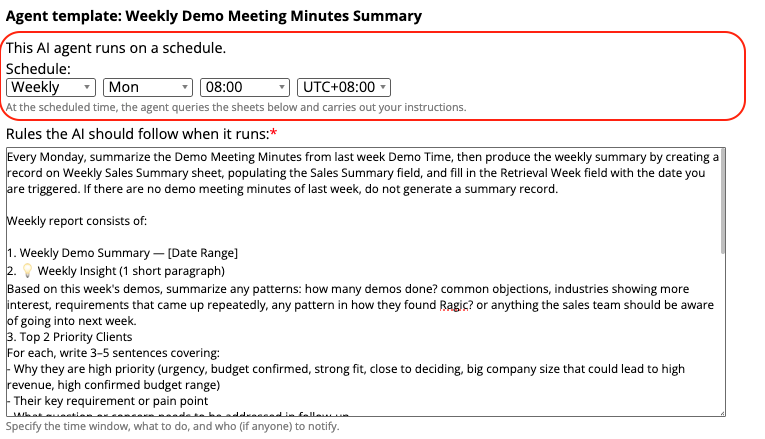
Change the schedule. By default, the Agent runs every Monday and covers the previous week's demos. If your team plans on a different day, or wants a report every two weeks, update the schedule in the AI Agent settings and adjust the date range rules in the prompt to match.
 Thank you for your valuable feedback!