

Maybe AI Isn't It — Why Real Businesses Still Choose Classic Tools
.png)
I write content for a no-code database platform that is currently developing our AI features pretty massively. So when I tell you this article isn't about bashing AI, I actually mean it. I'd be undercutting my own job if it were.
But a big part of my job is understanding what real businesses actually need, to shape our no-code platform. I talk to owners and the people running operations day to day. In the middle of everyone being AI-this and AI-that, a lot of them just aren't using it. Not in the workflow that runs their whole operation.
Scroll any feed and it's "my agent runs my business while I sleep" or "I fired five employees and replaced them with AI." I started to wonder: is this actually happening, or are those of us immersed in tech living in a bubble, assuming everyone else is as interested in this as we are?
The assumption baked into most of that content is that if you're not on the AI train, you're quietly falling behind, and one day the gap will catch up with you. But talk to the businesses actually running at scale without it, and a different picture shows up: some of them aren't just doing fine. They're outperforming companies that adopted AI, by the metrics that actually matter: compliance, error rate, audit speed, hours saved.
The more I talked to people, the more their reasons for skipping AI stopped sounding like resistance and started sounding valid. If you're one of the many wondering "am I behind?" (every tool now has an AI button, every newsletter warns you'll get left behind if you don't "leverage it"), I'm here to tell you: skipping it might be the correct call, for now.
Full disclosure: these are all people already using a no-code platform. Not exactly a neutral sample. But I'd argue that's the interesting part: they're not tech-averse at all. They built entire systems themselves, with no coding background. They just haven't found a reason to add AI to it.
Why fix something that isn't broken?
I talked to a director of special education at a public school district, who built his entire special-ed compliance system on a no-code platform eight years ago. He manages data for about 2,000 students and 250 staff, under legal timelines that leave no room for error:
- Evaluations completed within 60 days of consent
- Parent meetings within 30 days
- Referrals initiated within 7 days
Miss one, and it's not an inconvenience, it's a legal violation.
Eight years later, the system he built on day one is still the system running today.
"If it's not broken, don't fix it."
But you might be wondering: is "not broken" just barely surviving, or actually thriving?
Imagine their workflow:
- Every consent that gets signed automatically triggers the next step and starts a countdown for the assigned examiner.
- Parent consent and social history forms go straight into the database, without any re-entry.
- Medicaid prescriptions auto-populate from data that's already been entered once, and export to Word in a single click.
None of it involves AI. All of it has held up for eight years, in a domain where the cost of failure is a lawsuit. Safe to say this is the approach that has helped them "thrive" all these years.
Classic tools offer straightforward automation: clear conditional logic, if-this-then-that rules you define yourself. When your workflow fits that mold, a classic tool like no-code gives you something certain, without the risk of a model getting it wrong. Predictable rules aren't old-fashioned. They are accountable. Adding AI on top of that might just be overkill.
It might not always be about resistance to change
Two co-owners of a vegetation-management company working with oil and gas clients across several states built their own system over two off-seasons. One put it simply:
"I wasn't gonna use AI to build the pages because I can just do it."
That's someone who already knows how to solve the problem, deciding a new layer isn't worth it. Then he said:
"I don't go to the AI thing because I didn't grow up using AI, so I have it in my head that I have to do it myself... I don't even see that as a button (the button to activate the AI feature) that's there."
What might sound like resistance could just be simple human nature. Business owners are wired to reach for whatever's easiest: whatever saves time and generates revenue.
Is it quicker to just do it myself, or wrestle with something unfamiliar, with no guarantee how it turns out?
This same vegetation-management company has sharper numbers:
- Compliance recordkeeping that used to take each employee 20+ hours a month now takes five minutes.
- During a state inspection, officials noted that most companies' records reviews run several hours. This one took under five minutes.
That's a measurable edge over competitors, not just survival.
Read their case study without naming the tool, and it sounds exactly like the AI adoption stories you see everywhere right now: the time savings, the audit speed, the eliminated busywork. Minus the AI.
When you're already wearing ten hats, do you need another one: "AI babysitter"?
Many of these businesses have no one dedicated to double-checking a model's output. If something's 80 or 90% right, someone still has to catch the 10–20%, usually whoever's already carrying everything else, at night, after everything else on their list.
Since no model behaves at a 100% success rate, someone still has to decide what it's allowed to touch, what it's not, and build a way to catch it when something is wrong. That's one more obstacle on top of everything else, especially when you're not familiar with AI.
Tech influencers talk about how flashy and fast it all is. But does it hold up with a real, stable outcome for a real business? A classic tool, where everything behaves exactly the way you set it up, sounds a lot better than a guess that could suddenly delete five years of purchase orders, or mass-email your 1,600-contact list.
But it's not that simple
Not everyone I spoke with fit neatly into "AI isn't for me." One contact at a healthcare nonprofit uses a general AI assistant constantly, just not inside the platform he runs sales and outreach on.
"I started to work with it a little, but I stopped because I wasn't finding an effective way to use it for what we do... it's a great use case, but we don't have that ability yet."
It's not "I don't need it," it's more like "I want it, and it hasn't caught up to my problem yet." The gap is that AI hype has outpaced what AI can do for a specific, unglamorous workflow.
What people call "AI" is often just automation they haven't built yet
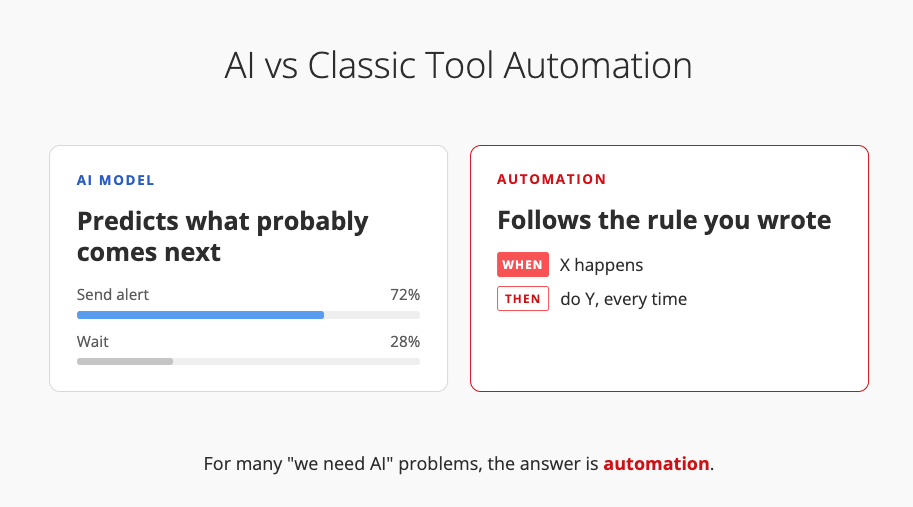
Here's the part that tends to get skipped: a lot of what people imagine AI will give them (a system that "knows" what to do next, that connects the dots, that saves them from manual busywork) isn't actually an AI capability. It's an automation capability. And the businesses in this piece already have it.
At the school district, the trigger chain is the whole system: a signed consent triggers an evaluation assignment, which triggers a deadline countdown, which triggers an alert to the right person. Instead of a human remembering to check a spreadsheet, it's that same kind of "the system knows what to do next" behavior people associate with AI. It's just built on explicit rules instead of a model's prediction.
At the vegetation management company, it looks like this:
- Proposals convert into sales orders with one click, which convert into jobs, which link to assets and invoices. No retyping anything.
- Job site weather and mileage get pulled in automatically based on the address entered, turning what used to be an hour of manual tracking per employee per day into a five-minute task at month's end.
None of this required a model. It required someone sitting down and mapping out: when X happens, what should happen next? That's automation. Most probably, for a huge number of "we need AI" problems, it's the actual answer.
And this leads to another point: AI Readiness
There's a version of this story that sounds like "these companies rejected AI." That's not quite it. What they actually did, without necessarily planning for this, is build the exact foundation AI needs in order to work well:
- Data that lives in one place instead of scattered across spreadsheets and inboxes
- Processes that follow explicit, documented rules
- Records clean enough to hand to an auditor with five minutes' notice
Their key to automation success is actually the foundation of what can also make AI successful, which is: AI Readiness.
It's the unglamorous, non-AI groundwork (centralized data, connected systems, rules spelled out instead of left as tribal knowledge) that determines whether AI, when you do add it, actually works or just adds noise on top of a mess.
This is also, not coincidentally, why so many AI pilots stall before they scale: the model gets layered onto data that was never centralized or cleaned up in the first place. The businesses in this piece are, without trying to be, further along that readiness curve than a lot of companies who've already started experimenting with AI. They're not behind. If anything, they've done the hard part first.
So, is it fine to skip it?
Yes, if it works for you now. There's a difference between AI hype and AI adoption. Adoption should happen when a tool is reliable, not exciting and new. If what you have already works, you don't owe anyone an upgrade because a timeline says so.
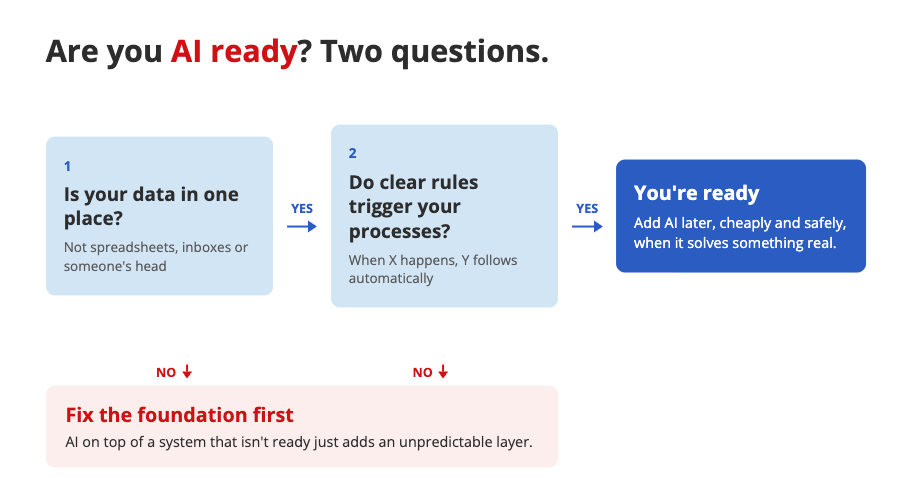
But "does it work for you now" isn't the only question worth asking. Two more useful ones:
- Is my data centralized? (Or still scattered across spreadsheets, inboxes, and someone's individual computer, or even just in one person's head?)
- Are my processes triggered automatically by clear rules?
If the answer to both is yes, you likely already have most of what people are chasing when they reach for AI, and you're in a strong position to add it later, cheaply and safely, when it actually solves something you have.
If the answer is no, adding AI won't fix that gap. It'll just add an unpredictable layer on top of a system that was never ready for it.
This isn't a "never use AI" piece. It's a "use it on your own timeline" piece.
When it's proven and actually solves something you have, you'll know. Until then, don't feel behind for building it the way you already know how.
Category: Tips and Tricks > AI