

It Basically Runs the Company: How Apex Unlimited Services Built a No-Code System That Saves 100+ Hours a Month
| Company Name | Apex Unlimited Services |
| Industry | Vegetation Management Services |
| Scope of Business | Thousands of locations across 3 states |
| Benefits of Implementation | |
| Customer Feedback | “If you're willing to think through your workflows, you can build systems that would normally require extremely expensive enterprise software.” |
| Applications | Asset Management, Inventory Management, HRM, Sales Order Management, and more |
| Subscription Plan | Professional |
| Access Platforms | Web browser and mobile app |
| Frequency of Use | Used daily, with continuous off-season workflow improvements that don't disrupt operations |
From serving as an inventory tracking tool to becoming a company-wide system, discover how co-founders Jonathan and Robert (“Rob”) decided to move 95% of their business processes to Ragic— What they do, the challenges they faced, and the solutions they built to achieve digital transformation.
Who is Apex Unlimited Services?
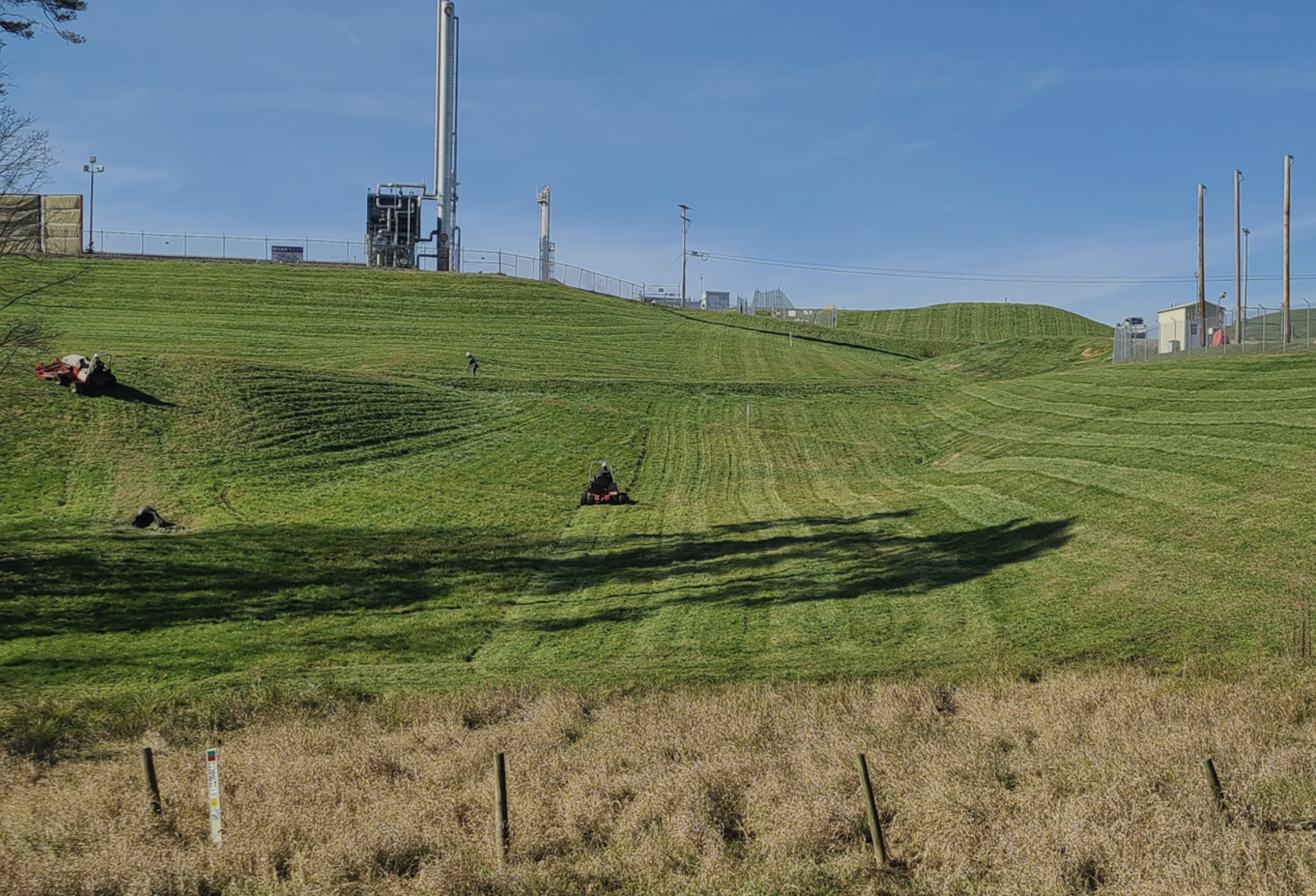
When visiting natural gas or oil production facilities, you’ll often notice that plants have been cleared and replaced with gravel to reduce fire risks. While this may sound simple, maintaining these sites is far more complex than it appears. Work is often carried out in hard-to-reach environments such as steep slopes and remote production areas, where everyday garden landscaping methods don’t apply. As Rob put it, “We cut one place 80 acres. It's like the size of a town. So we're not doing lawn care where it's 50 bucks a lawn for a little square.”
These jobs usually require large-scale operations, including heavy bush clearing, commercial mowing, and targeted herbicide applications to keep expansive sites safe and operational.
Apex Unlimited Services is a vegetation management company operating across Pennsylvania, Ohio, and West Virginia. They work with large natural gas and oil companies, as well as local municipalities, supporting environmental safety through herbicide application, commercial mowing, right of way mowing, and pond retention, among other services in challenging terrain.
Compared to other businesses providing similar services, Apex stands out by leveraging technology to provide more efficient, accurate, compliant, and cost-effective services that increase customer satisfaction.
By enabling real-time tracking and verification of work, this improves client trust while streamlining internal coordination across multiple locations and reducing manual follow-ups.
The Challenge
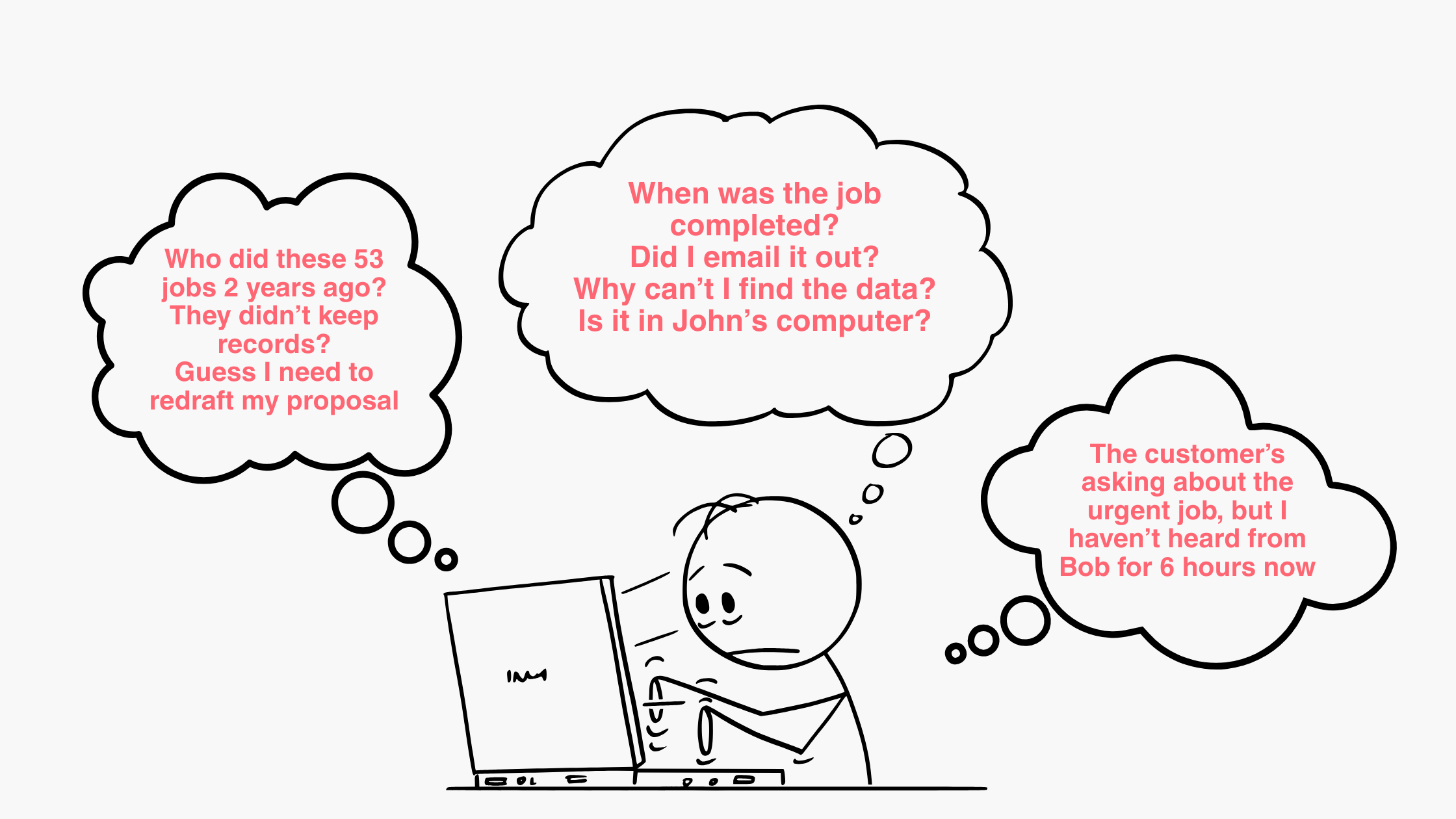
Like many companies, Apex started out using spreadsheets like Microsoft Excel and Google Sheets, which they found lacking in data linking, subtables (line items), and historical query capabilities. They also used an out-of-the-box field service management software called Jobber. Being in the service industry themselves, the Apex team hoped that Jobber would be able to meet their needs. However, they were disappointed with the platform’s limited features and buildability.
Due to this limitation, the Apex team spent hours on manual operations and information back-and-forth. For instance, they would handle bids on Quickbooks, then manually bring in all the information into Jobber for job recording and scheduling, and return to Quickbooks for invoicing. Information was decentralized, data transfers were prone to errors, and processes were inefficient. The Apex team knew that things had to change.
The Solution
Determined to find a better way to manage their data and workflow, Jonathan turned to Google searching for data management solutions and found Ragic. Amidst the various options available, Jonathan initially chose to try Ragic due to its no code, intuitive interface and data relationship capabilities. While Jonathan has coding experience, Rob specializes in thinking through workflow logic and operational efficiency. By choosing a no-code platform like Ragic, both founders are able to collaboratively build and refine the system together— from sheets and forms to workflows and automations.
At first, Jonathan was only using Ragic’s inventory template; but when Rob saw Ragic and realized that he could use logic to customize and build things intuitively, he started moving some processes from Quickbooks to Ragic. Today, all of Apex’s business processes are handled in Ragic, except for Accounting— which the team decided to keep in Quickbooks.
Some Systems They Built
1. Fragmentation to Connection: How Link & Load Tied Everything Together
For Apex, the shift happened when everything was finally brought together in one place. Before Ragic, their work lived across scattered spreadsheets, emails, and different devices depending on who worked on the job or was in the field. Information existed, but it was fragmented, hard to track, prone to unnecessary duplication, and even easier to lose.
When they started building their system with Ragic’s Link & Load feature, it became the backbone of how their data connects, like how proposals flow into jobs and how jobs link to assets and maintenance records. As they exclaimed, “Nothing beats link and load. You can’t have Ragic without that!”
Their system moved from separate sheets and forms to a single operational workspace. They were even able to seamlessly integrate their workflow with Quickbooks by building sheets and forms that match their format, making it easy to transfer information without manual re-entry and reconciliation.
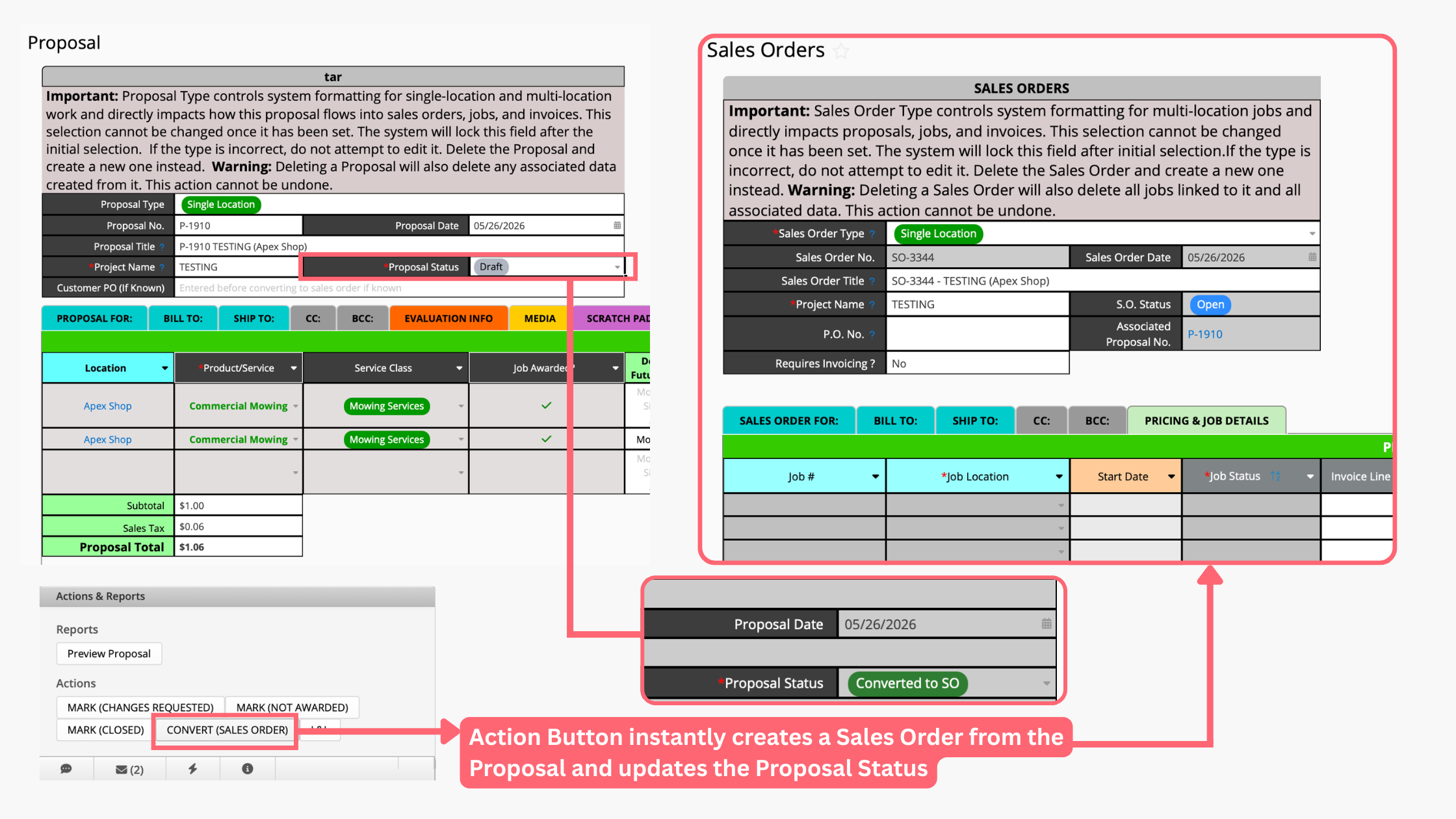
2. One Click Forward: Proposal → Sales Order → Job → Invoice
Using the convert records action button, the Apex team is able to automatically generate sales orders using information already entered in the proposal sheet, eliminating the need for repetitive data entry. Once a job is completed and ready for billing, Rob can generate and send the invoice with just a few clicks.
3. Effortless Field Scheduling with Customer Updates in Under a Minute
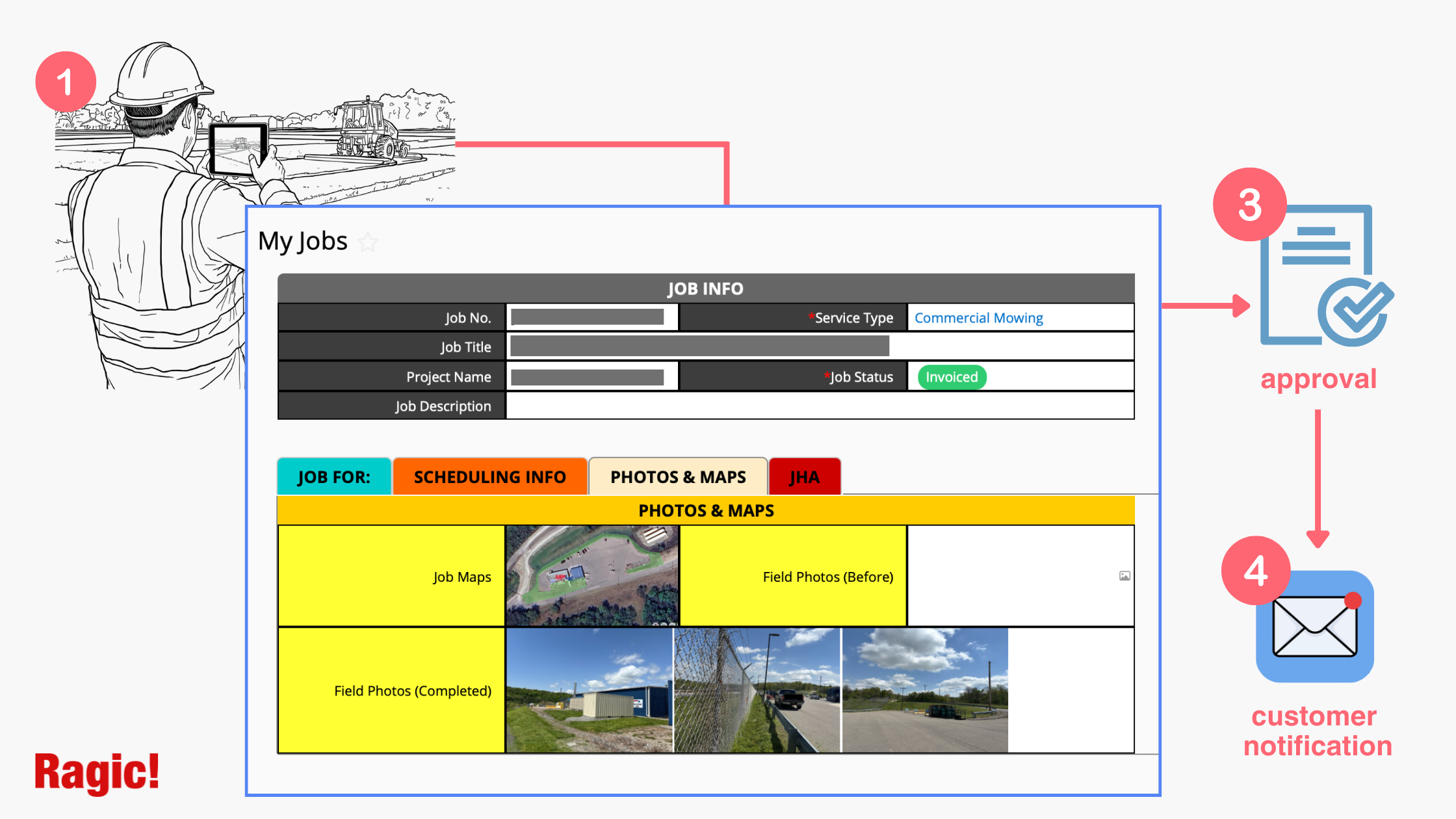
To address connectivity challenges in remote job sites, each truck is equipped with a Starlink satellite internet device, while employees use iPads to capture photos, record field data, and report equipment issues directly from the field.
When a job is completed, employees simply take a photo, upload it to the database through Ragic’s mobile app, and initiate the approval process. Once approved, the system automatically notifies the customer that the work has been completed and includes the uploaded photo as verification. This not only improves transparency and communication with clients, but also speeds up reporting, reduces manual follow-ups, and creates a clear digital record of completed work.
4. Automatic Weather and Mileage Tracking Saves 100+ Hours Every Month
As part of the regulatory requirements for licensed herbicide application, the Apex team must maintain detailed records of the herbicides and chemical blends used for every job. In addition to this, they also track weather conditions, which play a critical role in ensuring safe and compliant applications.
For example, when performing herbicide work near farmland, weather conditions such as wind and rain must be carefully monitored to prevent chemicals from drifting into nearby crops or being washed into unintended areas. To streamline this process, the Apex team built an automated workflow in Ragic using Make integration. Based on the address entered into the system, job site coordinates are automatically retrieved, while corresponding weather information is automatically populated directly into the Ragic sheet.
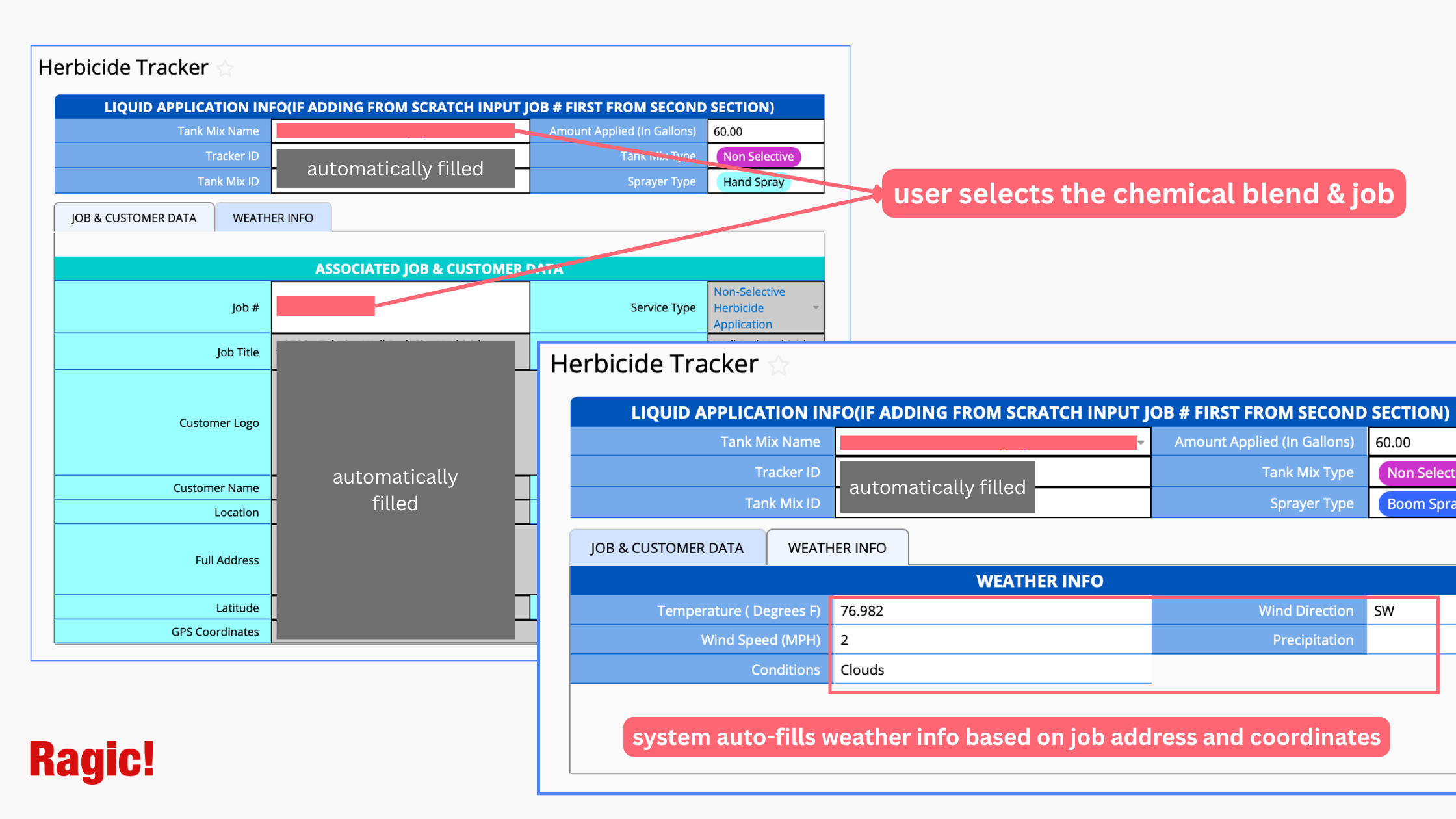
In addition to retrieving coordinates and weather data, the system also automatically calculates travel distance and mileage records required for regulatory reporting to the Occupational Safety and Health Administration (OSHA). Previously, compiling this information manually took each employee roughly 1 hour a day— adding up to 20 to 30 hours every month. With their automated workflow in Ragic, they now only spend 5 minutes at the end of the month for this task.
By automating these processes, Apex is able to maintain accurate compliance records, improve accountability, and reduce environmental risk across the sites they service.
5. No More Delays in Equipment Maintenance Reporting
The Apex team maintains records of their operational assets, including equipment, aquatic tools, trailers, trucks, and other vehicles. To manage maintenance issues, they built a Maintenance Request workflow in Ragic where employees can submit their preventive maintenance requests or reactive ones for equipment that breaks down in the field.
When an issue occurs, field employees simply scan the barcode on the machine, indicate that the issue is reactive, select the relevant team members to notify, and answer some safety-related questions. Based on these responses, the system automatically determines the priority level of the request. If certain safety or usability criteria are met, the equipment is also automatically removed from the list of available assets until it can be repaired or inspected.
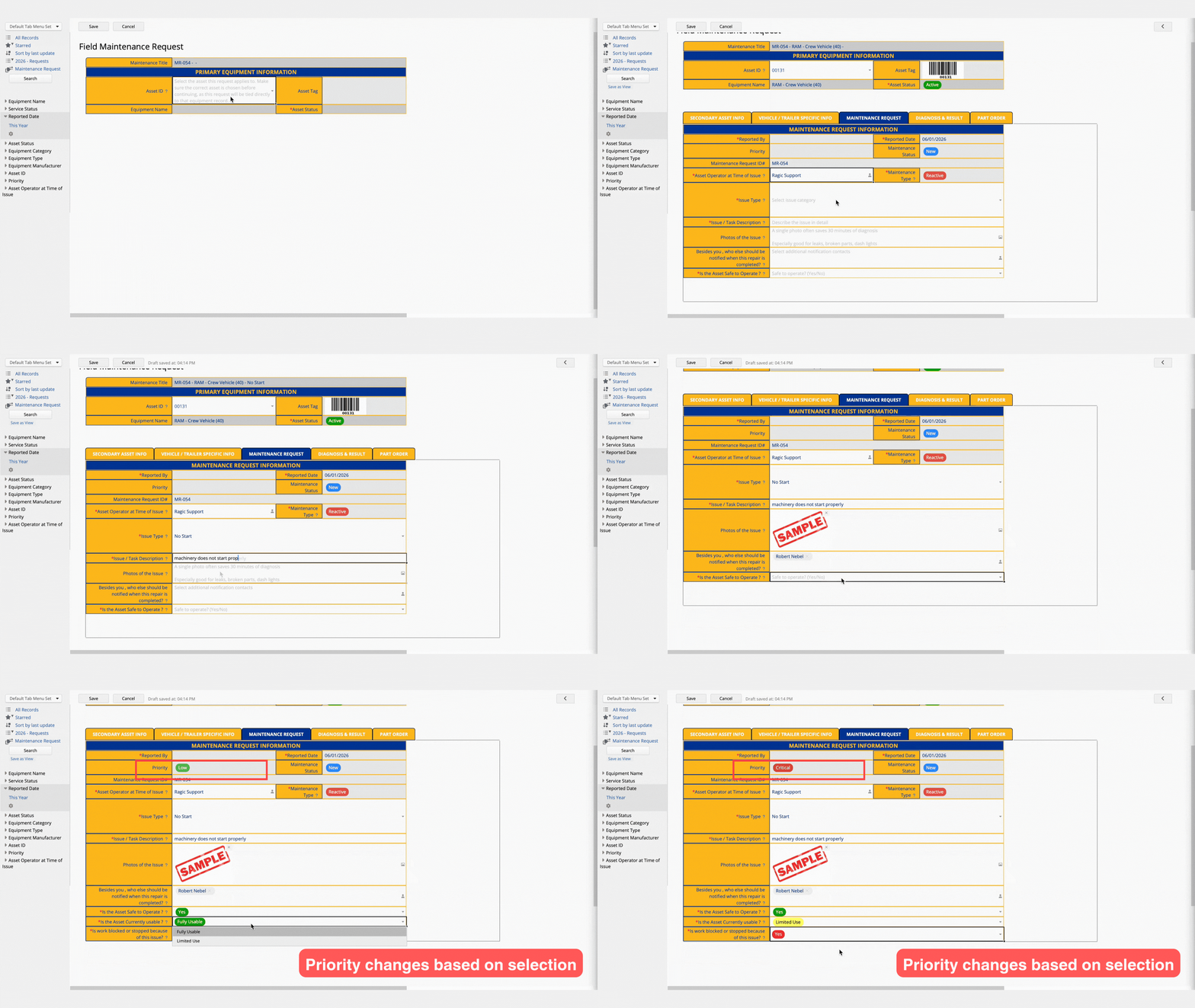
Jonathan implemented this workflow using a combination of Ragic’s built-in features together with custom JavaScript:
The result is a more consistent and efficient maintenance process that improves safety, reduces manual coordination, and minimizes the manpower needed to manage equipment issues across the field.
The Results
From manual workflows, time-consuming processes, and disconnected data spread across multiple systems and computers, the Apex team is now able to streamline operations, improve transparency, strengthen customer relationships, and stay compliant with government regulations far more efficiently than before.
In many ways, the impact extends beyond internal operations. During a state inspection, officials reportedly noted that reviews with most companies typically take several hours due to incomplete or poorly organized records. In Apex’s case, however, the inspection was completed in under five minutes after reviewing how thoroughly the company tracked their data.
It’s a clear reminder that when operational systems are properly structured and digitized, the benefits create a ripple effect— improving trust, compliance, and efficiency across everyone involved. More importantly, it also shows how much of this transformation comes down to having the right system design in place to turn everyday operations into something structured, traceable, and scalable.
Category: Case Studies > Services