
In production management, material requisition is the process of moving materials from the warehouse to the production line. Although it sounds simple, it plays a significant part in data management.
In factories without a proper requisition system, the warehouse often functions like a communal refrigerator: Anyone needing screws grabs a handful, and anyone short on panels takes a box. The biggest danger of this approach is inventory discrepancies between records and reality. While the system might show 500 screws in stock, staff may arrive on-site and discover that the inventory has already run out.
The core purpose of having a material requisition system and process is the ability to link the flow of materials to specific production tasks, such as work orders or manufacturing order numbers. For example, a material requisition form may look like this:
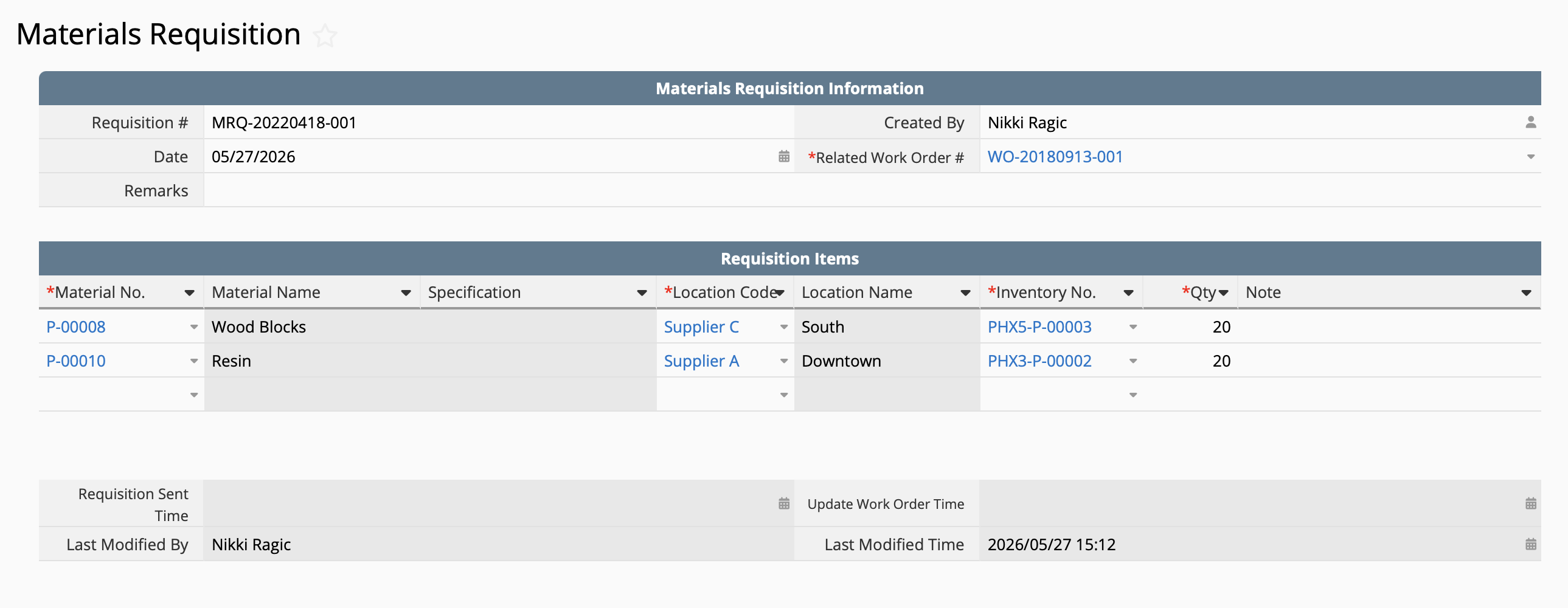
When the materials on the document are issued and signed for by the recipient, the system immediately records the deduction as “material issuance under MRQ-20220418-001.” When inventory management personnel need to trace the flow of materials, they can instantly retrieve the record and even link it to the relevant production orders and work orders.
Material requisition systems address two core pain points on the production floor:
For instance, a system can automatically calculate the required amount of wood blocks or resin needed to produce 40 chairs based on the Bill of Materials (BOM). During requisition, warehouse staff issue goods based on this quota. This principle— using the requisition slip as the sole authorization for issuing materials— prevents floor operators from taking excess parts for convenience, which would otherwise lead to production line clutter or unnecessary losses.
If one day you discover that a batch of the chairs has an unusually high defect rate— perhaps due to poor storage conditions causing mold issues with the wood, you can precisely trace which date these chairs were produced and which batch they came from through the material requisition records. This traceability is especially crucial in industries such as food, pharmaceuticals, and precision manufacturing. In ensures that when problems occur, the company will not need to discard all the inventory, but only specific production batches.
The way material requisition is initiated may differ from one factory to another. Some companies use an "issuance" (Push) system, where the warehouse proactively checks the next day's production plan, prepares materials in advance, and delivers them to the production line. Others use a "requisition" (Pull) system, where on-site operators proactively request materials from the warehouse based on current progress.
Regardless of the method, the essence of management remains the same: Every piece of material leaving the warehouse must have a clear "destination." This is why requisition forms must be closely linked to work orders or production order numbers. Without this link, the consumption of materials may become unaccounted expense, eventually causing a complete disconnect between the financial costs and actual situation.
Once requisition is completed, these materials no longer qualify as "raw materials" in accounting terms. Instead, they enter the "Work-in-Progress" (WIP) stage. This represents materials that are on their way to becoming a finished product—much like wood blocks that have been cut into backrests. Although not yet assembled into a finished chair, the material can no longer be redirected for other purposes.
This status shift serves as an indicator for management to judge the degree of "resource lock-in." If you find the warehouse empty but few finished products in stock, a large number of semi-finished products is often hidden in countless unresolved material requisition forms.