

From Zero to Full-Time: How the Lown Institute Built the Operational Backbone Behind Its Hospitals Outreach
| Organization Name | Lown Institute |
| Industry | Healthcare research |
| Scope | 3600+ hospitals nationwide (Hospitals Index) |
| Benefits of Implementation | |
| Customer Feedback | “I would tell our sales team: Don't set up your own spreadsheets to keep track of all the work because Ragic should be able to do that for you. You should be able to press a button and get exactly what you need. And if you can't, then tell me and we'll make it happen.” |
| Applications | CRM, Sales Order Management, Contact Management, Communications Tracking |
| Subscription Plan | Professional |
| Access Platforms | Web browser |
| Frequency of Use | Used daily |
When we asked John Talbot, MBA, JD, the VP of Finance and Administration from Lown Institute to describe his journey with Ragic for the last 5 years, he gave us an analogy we never saw coming:
“Five years ago it (Ragic database) had some basic functionality, then every year it’s gotten better and better. We figured out where the sticking points are, what we actually need to make it successful.
“Ragic allows us to do what we need to do: promote the Index while organizing and recording an enormous amount of information and communication efficiently.It sends out really nice looking communications very easily. Ragic just keeps getting better and better and we benefit from having more data, having more connections between the data and simplified workflows.”
When Lown Institute launched its Hospitals Index seven years ago, they needed a platform to organize and assist with outreach and the team was building from the ground up. They knew they needed a system that could support their immediate needs while scaling alongside the Index project as it grew. Today, the Lown Hospitals Index has become a trusted benchmark for hospital performance, widely recognized and respected across the industry. Ragic has enabled Lown to work with hospitals included in the Index to understand and promote their performance.

Who is the Lown Institute?
Founded in the early 1970s by Nobel Peace Prize laureate and defibrillator inventor Dr. Bernard Lown, the Lown Institute is a healthcare think tank dedicated to creating a more just and equitable healthcare system. Among its many initiatives, including the Shkreli Awards and the Bernard Lown Award, its flagship project is the Lown Institute Hospitals Index.
Unlike traditional hospital rankings that focus primarily on reputation and clinical performance, the Lown Institute Hospitals Index evaluates more than 3,600 hospitals across the United States through the lens of social responsibility. Using 50+ performance metrics, including pay equity, inclusivity, patient outcomes, and cost efficiency, the index provides a broader picture of how well hospitals serve both their patients and their communities.
These insights benefit a wide range of audiences. Healthcare workers can see how their hospitals compare with their peers, while hospital leaders can identify strengths and opportunities for improvement. Policymakers can better understand whether nonprofit hospitals receiving substantial tax benefits are delivering meaningful community value. Patients and families can use the index to find local hospitals that provide high-quality, inclusive, and equitable care— not just care to those with the biggest names. Remarkably, all of this is accomplished by a team of just 14 people.
To learn how such a small team coordinated their outreach to promote one of healthcare's most trusted hospital performance benchmarks, we spoke with John Talbot, MBA, JD, Vice President of Finance and Administration at the Lown Institute. John oversees all of the organization's back office work, including legal, financial, human resources, and administrative operations, enabling the rest of the team to focus on research, analysis, outreach, and their respective responsibilities.
The Challenge
Shortly after launching the Hospitals Index, the Lown Institute recognized the need for a system to support ongoing engagement with hospitals and healthcare systems— a system that could help Lown communicate with hospitals, help them understand their performance, and promote their achievements through press releases and digital “badges.”
By the fall of that year, he had begun searching for a platform that could grow alongside the project:
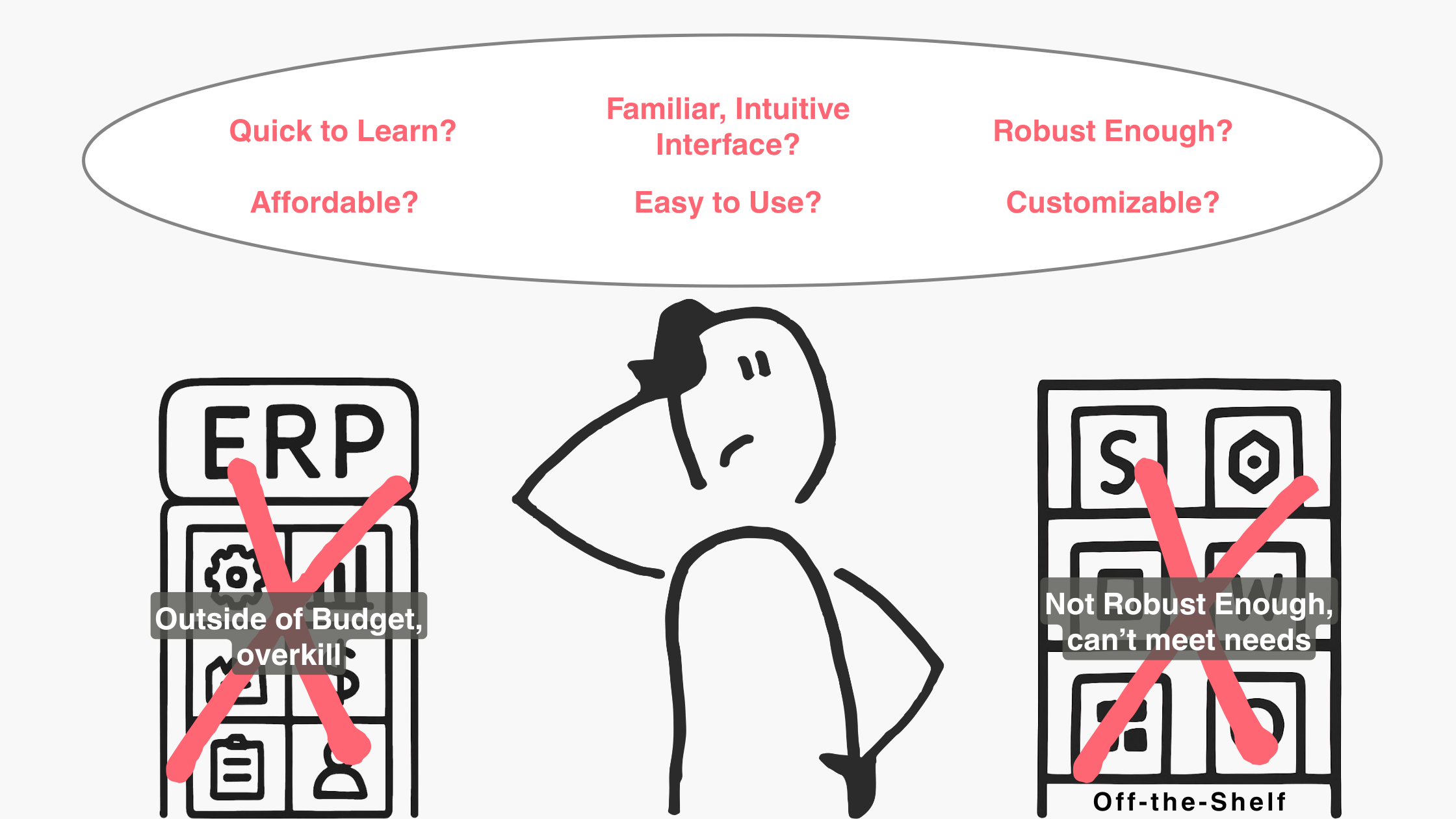
The challenge was more than just finding a CRM; it was finding an online system flexible enough to manage their unique workflows. Most of the platforms John evaluated were designed to track straightforward information like contacts. However, Lown needed a centralized system capable of managing detailed product information, mapping relationships between hospitals and healthcare systems, tracking every stage of the sales process, and preserving years of historical records as the Hospitals Index continues to grow.
Of course, traditional enterprise tools like SAP or Oracle could be customized to handle these requirements; but that would involve large implementation costs and complexities. For a nonprofit organization like the Lown Institute, they simply weren’t a practical option.
The Solution
John’s search ended when he discovered Ragic, which stood out because of its combination of familiarity and flexibility. Unlike other platforms he evaluated, Ragic provided a spreadsheet-style interface that felt intuitive while offering the power to build a customized database without writing code.
For the Lown Institute, Ragic struck the balance they had been searching for— more powerful and customizable than the lightweight tools on the market, yet dramatically more accessible and affordable than traditional enterprise systems.
Mapping Relationships Between Hospitals and Systems
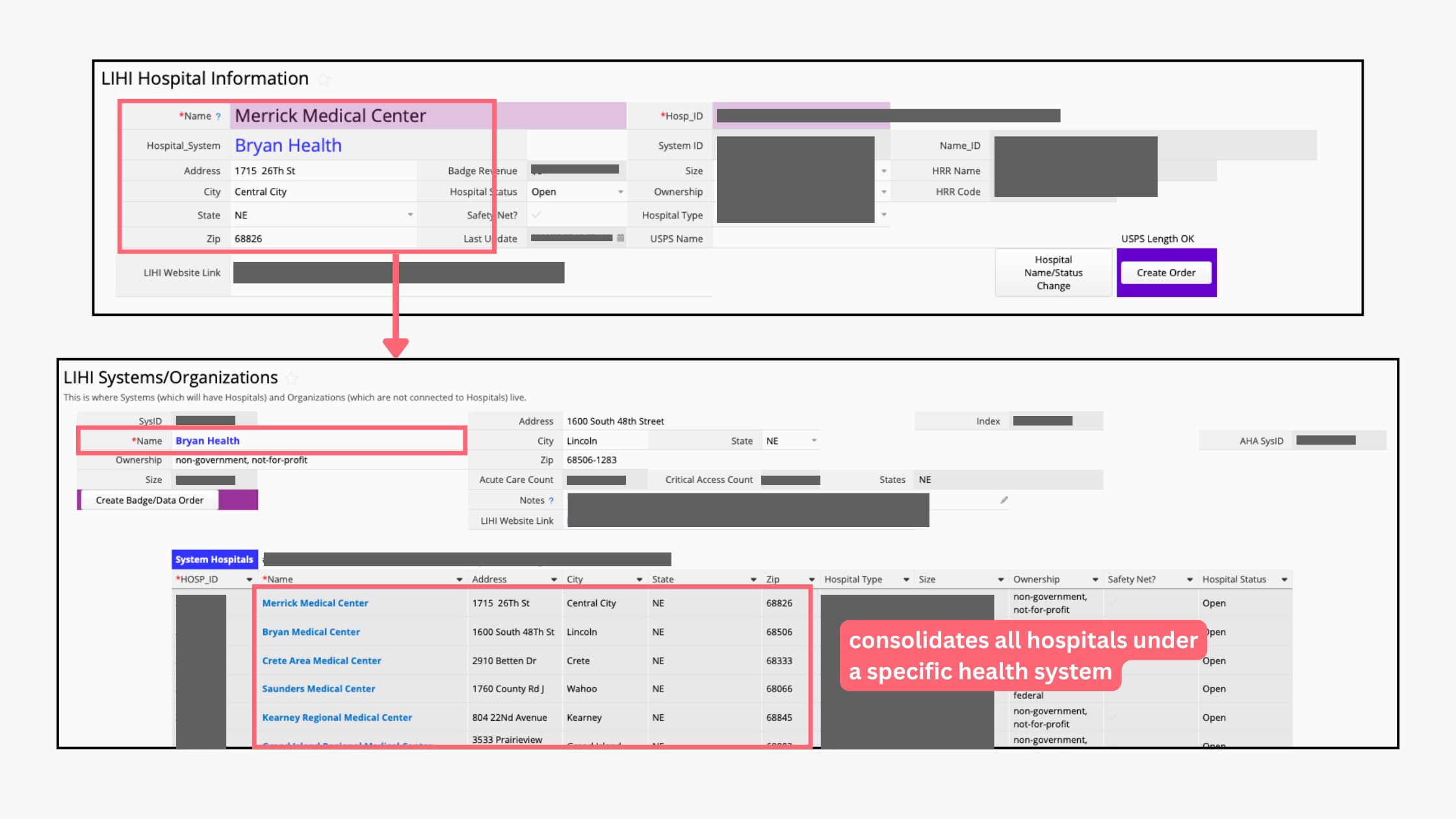
The Hospitals Index doesn’t just track individual hospitals. It also tracks how they relate to larger health systems. As hospitals merge, change relationships, or become part of new organizations, those relationships must be accurately reflected throughout the records.
Rather than maintaining disconnected spreadsheets, the Lown team built relational data links and subtables in Ragic that connect hospitals with their respective health systems. This allows staff to navigate between connected organizations, maintain consistent information across records, and better understand how organizational changes affect the broader system.
Maintaining these relationships also simplifies day-to-day operations. Instead of updating information in multiple places or piecing together organizational structures manually, staff can follow the links between hospitals and health systems to see how records are connected. This reduces duplicate work while making it easier to keep information accurate as organizations evolve.
Generating Agreements and Sales Orders in Seconds
All hospitals recognized by the Lown Hospitals Index, such as the No. 1 hospital nationwide or the top 10 hospitals in each performance category, can purchase digital badges to showcase their achievements on websites, marketing materials, and other promotional assets.
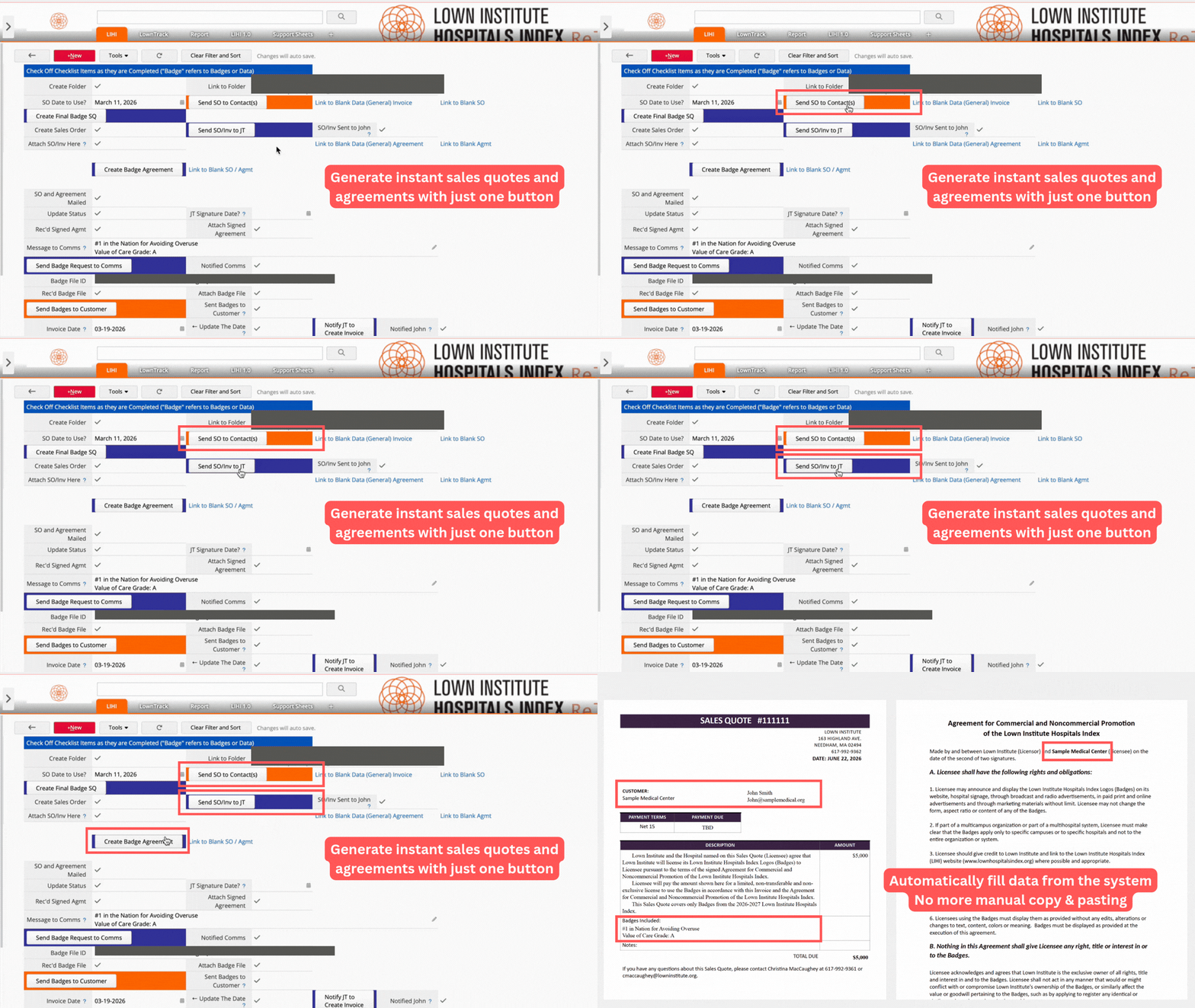
To support this process, the Lown team built a workflow in Ragic that automatically generates pre-filled sales orders and agreements with a single click.
Instead of manually copying customer information into multiple documents, all the necessary data is pulled directly from the database. The documents are generated in their preferred layout and formatting, allowing the team to produce polished, customer-ready PDFs in seconds.
The best part is that they can format these PDF files in whatever format, style, or font they want.
Tracking Every Stage: Approval Workflows and Data Integrity
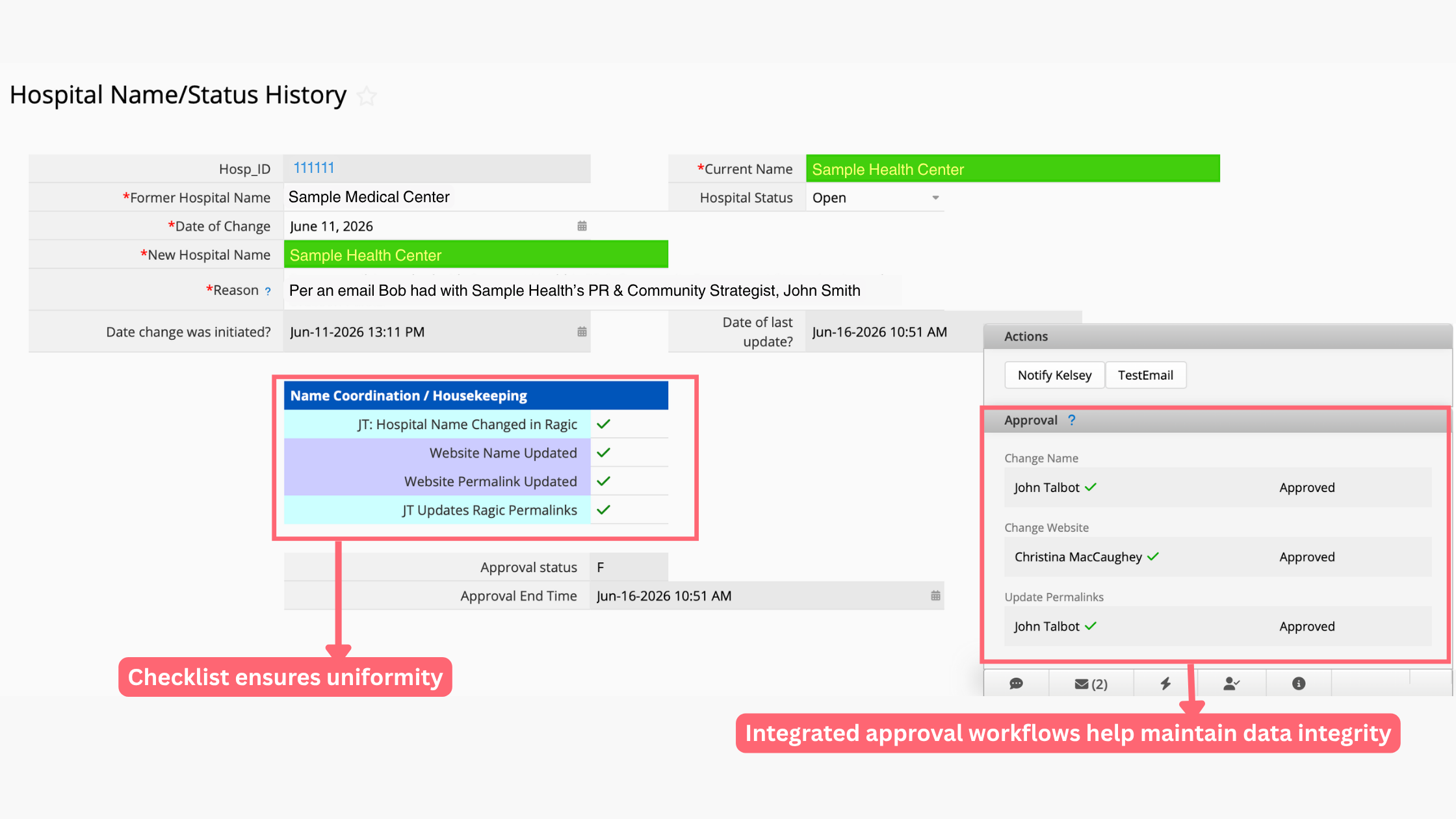
Maintaining accurate hospital data is essential. Even something as seemingly simple as a hospital name change can have far-reaching implications, affecting public rankings, historical records, website content, and links.
Because hospitals frequently undergo mergers, rebranding, or organizational restructuring, the team receives regular updates on name changes. However they can’t solely rely on what they’re told. Every change must first be verified to ensure the information is accurate before it becomes part of the official database.
To support this process, the Lown team built an integrated approval workflow in Ragic. Proposed changes are reviewed and verified before they are applied, helping ensure that updates are accurate and reflected consistently across all relevant records.
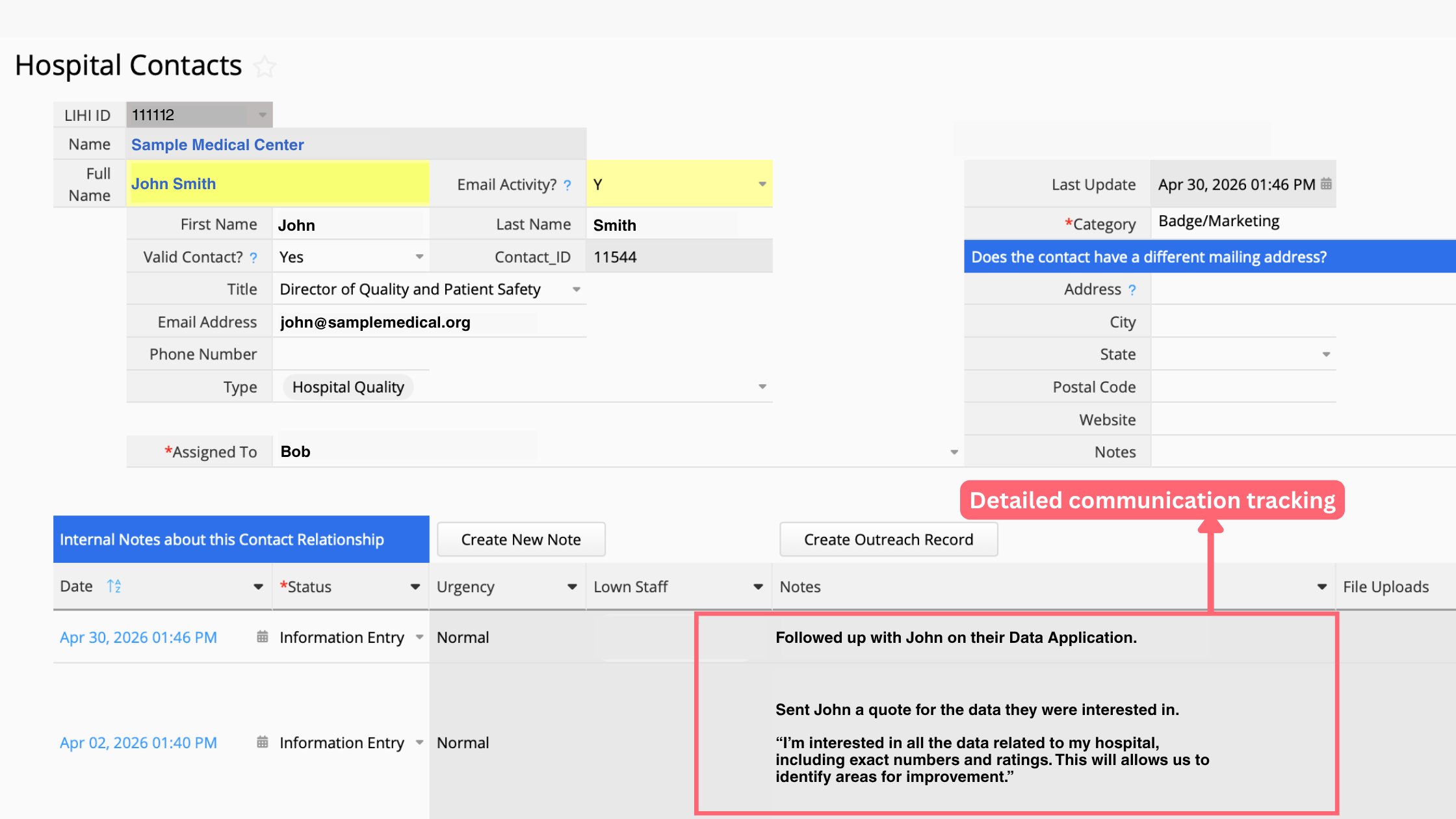
Preserving Records: Keeping Every Conversation in Context
For the Lown Institute, outreach is an ongoing part of daily operations. Whether it’s answering questions from hospitals, following up on badge orders, or maintaining long-term relationships, every interaction matters.
To make those conversations more effective, the team keeps each hospital’s information in one place— including contact details, award and badge history, contact records, and a complete record of past communications. Rather than searching through emails or relying on memory, staff can instantly see the full history before picking up the phone or sending an email.
The team also connects their financial workflow to Ragic. When invoices and other customer emails are sent from QuickBooks, they’re captured in Ragic and associated with the relevant customer or order history:
"Ragic lets us create a record when someone emails us with a question. An ‘issue’ is created with as much information from the mail as possible, and then Ragic handles reminding us to ensure we respond and resolve that ‘issue,’ or convert it into a new contact and attach it to a hospital.”
Whether a staff member is responding to a question, following up on a badge purchase, or reviewing previous invoices, they can immediately understand the full history of the relationship from a single record. This gives the team a more complete view of communications without having to search across multiple systems. As the Hospitals Index continues to grow, preserving that institutional knowledge becomes increasingly valuable.
A Seamless Extension of Lown's Brand
Productivity and automation shouldn’t come at the expense of professionalism. Every email, agreement, and document sent by the Lown Institute represents the organization’s brand, making consistency just as important.
With Ragic, the team isn’t limited to generic templates or system-generated documents. Instead, they can fully customize emails and PDF files to match Lown Institute’s existing branding, layouts, and visual identity. The result is a seamless experience where operational workflows and marketing communications work hand-in-hand, ensuring every customer touchpoint feels polished, professional, and consistent.
The Consistent, Helpful Support Team
Choosing the right software was only the first step. As the index grew, so did the database behind it.
Building a unique system naturally came with questions; and John regularly reached out to Ragic’s support team for guidance on designing workflows, creating data relationships, and refining the database as new requirements emerged. Throughout the process, having knowledgeable and responsive support became just as important as the software itself.
The Results
Seven years ago, the Lown Institute built the Hospitals Index from the ground up and needed a system to coordinate interactions with hospitals and systems about their performance. They needed a system that could adapt to their unique workflow, scale alongside the organization, and support a growing volume of outreach, sales, and operational data. Today, that same system helps drive one of the healthcare industry's most respected hospital performance benchmarks.
As the Lown Institute Hospitals Index expanded, so did the opportunities it created. What began as a small operation has grown into a sustainable program supported by dedicated processes and a dedicated staff:
Category: Case Studies > Healthcare